Please Note: Tanzania has adopted a regulation prohibiting using or possessing single-use plastic bags (excluding small Ziploc bags), which have become an environmental issue there. This new regulation is particularly noteworthy because it becomes effective on June 1, 2019. Penalties for violating the regulation have not been made public. Still, for guidance, in nearby Kenya, the penalties are extremely severe: a fine of up to $40,000 or four years in prison for simply possessing a plastic bag. By banning plastic bags, Tanzania is joining more than 60 other countries that have banned, partly banned, or taxed single-use plastic bags, including China, France, Rwanda, and Italy.
As you prepare for your journey and consider what to pack, we strongly urge you to keep this new regulation in mind. Please also carefully inspect your luggage and any carry-on bags you plan on using to ensure no forgotten plastic bags lurking in any pockets or compartments.
This African safari is a very casual tour. Comfortable and casual clothing is recommended for both day and night. Formal and resort attire is not required.
Generally, lightweight, cotton, short- and long-sleeved shirts, long pants, and shorts are sufficient. A light jacket, fleece, or windbreaker, as well as layers of clothing, are suggested for cooler temperatures during early morning game drives and evenings. A bandana or cotton scarf will always come in handy. Be prepared for daily highs ranging from the mid-70s to the mid-80s and lows in the 50s and 60s except during the cold season (June, July, and August) when the lows can drop down into the 40s. The rim of the Ngorongoro Crater can get significantly colder during the night and early mornings due to the high elevation (7,500 – 8,000 feet).
While on safari, you may prefer to wear natural, earth-toned clothing, such as khakis, tans, browns, and greens (this is not imperative; other colors are fine), as well as comfortable walking shoes (hiking boots are not necessary). Dark, black, or navy blue clothing is not recommended while on safari as these colors have been known to attract biting tsetse flies. It is also advisable to bring a swimsuit, hat, sunscreen, sunglasses, and lip protection. Some stretches of unpaved road travel during game drives can be quite bumpy.
Game drives can be dusty, so wear something that can be washed while on safari. Clothes may be laundered at all camps for a nominal fee. Most lodges and camps will launder your clothes for free or for a small fee ($2 – $3 per item) within 24 hours. Loose-fitting, casual, and comfortable clothing is recommended.
A personal kit with medication for possible upset stomach, aspirin, and allergy medicine may also be useful. If you are taking prescription drugs, bring a prescription signed by your doctor in case you need an emergency refill while traveling. Insect repellent with DEET is a very important item to include in your kit. Pre-moistened towelettes, antibacterial lotion, and a flashlight will also be useful on your safari.
Pack your medical kit in your carry-on bag along with an extra pair of prescription glasses or contact lenses and a change of clothes in case of luggage delay.
For viewing wildlife, we recommend you bring a good pair of binoculars and your photography supplies, such as plenty of film, batteries, a 200mm telephoto lens, lens cap, lens papers, UV filter, and, for video recording, an adequate supply of video cassettes.
Please see below for a recommended African safari packing list:
Safari Clothing
– > One pair of comfortable walking shoes (i.e., sneakers, cross-training, or light hiking shoes)
– > Casual, comfortable, and loose-fitting clothing in khaki, brown, beige, green, and olive colors
– > T-shirts and light tops
– > Long-sleeved shirts/blouses
– > Shorts
– > Light long pants or convertible long-short pants
– > One warm fleece or sweater
– > Socks and underwear
– > Pajamas
– > Hat and bandana
– > Heavy sweater, warm gloves, knit hat, and scarf for the cold season (June – August)
– > For the ladies, you may consider wearing a sports bra while out on game drives as the roads can be a bit bumpy
– > Recommended but optional: lightweight jacket or windbreaker
Other Items
– > Passport, plane tickets, safari itinerary, and emergency contact document
– > U.S. dollars in large and small denominations and credit cards
– > Small flashlight
– > Sunglasses
– > Sunscreen and lip balm
– > Insect repellent
– > Contact lens solution, spare glasses, and extra contact lenses
– > Waterless anti-bacterial gel, hand wipes, and Kleenex
– > Camera, plenty of film, extra batteries and charger, if applicable
– > UK plug adapter
– > Small battery-operated alarm clock or watch
– > Playing cards, small games, and reading material (see safari reading list)
– > Journal or notebook for recording daily observations and pens
– > Snacks – nutrition bars, nuts, candy, etc.
– > Ziploc bags for toiletries, camera equipment, snacks, and small trash bags
– > All rooms at each lodge/camp have soap and shampoo
– > Small medical kit including: aspirin, antimalarial pills, cold and allergy medicine, cream for itches and rashes (i.e., Benadryl itch relief stick), band-aids, stomachache medicine (i.e., Pepto-Bismol), antibiotic ointment (i.e., Neosporin), multivitamins, diarrhea medicine (i.e., Imodium), prescription antibiotic effective against a broad range of bacteria including travelers’ diarrhea (i.e., Ciprofloxacin commonly known as Cipro), and any prescription medications.
– > If you have back issues, you may wish to consider bringing along a travel pillow to pad the safari seat over the bumpy roads (it can also double as a tool to steady your camera while taking pictures)
– > If you wear contact lenses, you should also bring along a pair of glasses in case your eyes get irritated from the dust
– > Be sure to bring enough cash. Credit cards are not accepted everywhere, and there are no ATM machines out in the bush. See the money section for more information.
– > As a safety precaution in case of a lost passport, we recommend that all guests carry a photocopy of their passport in a separate piece of luggage or scan and email your passport to your ADS sales representative.
– > Small battery-operated hand-held fan (some come with water reservoirs)
– > Tanzania Visa
– > Yellow Fever Vaccination Certificate if traveling from a Yellow Fever-infected country such as Kenya, Rwanda, or Uganda
We recommend lightweight clothing with moisture-wicking technology that draws moisture away from the skin to help keep you cool and dry. Many options are available from various online outdoor outfitters such as REI that are ideally suited for warmer climates and many feature stretchy fabrics for maximum comfort with built-in UPF (Ultraviolet Protection Factor) sun protection and even vented side seams.
Luggage Guidelines and Recommendations
Flight Restrictions and Excess Luggage
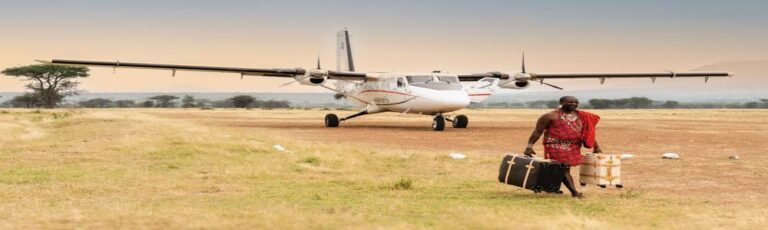
Most flights within East Africa, including the flight from Arusha to the Serengeti, have a baggage restriction of 33 pounds per person. This 33-pound limit pertains to the total combined weight of all your luggage and carry-on items, including backpacks, purses, camera gear, camera bags, etc. Excess luggage over and above the 33-pound allowance is charged at $3 per pound if it can be accommodated on the flight. For the standard Serengeti flight included in most itineraries, we’ve found that usually any excess luggage can be accommodated as long as you’re willing to pay the $3 per pound excess baggage fee and the excess luggage is within reason (i.e., about 5 to 7 pounds over the limit). Excess luggage that cannot be accommodated on your flight will be flown out on the next available flight (there are at least two flights a day to/from the Serengeti).
If you’re a serious photographer with heavy gear, you may wish to purchase an extra seat for your internal flight(s) to avoid any luggage restrictions. Soft-sided luggage is preferred for the flight to the Serengeti, but hard-sided luggage is allowed. The cargo pod measurements for the bush planes can be as small as 14.5 inches by 27 inches, so please ensure your luggage is not larger than these dimensions.
If you have extra luggage that you won’t need for the safari (e.g., extra luggage for pre-safari or post-safari travel, books you read on the international flight over, etc.), you are welcome to leave these excess items for safekeeping with our staff in Nairobi or Arusha. They will store your items at our secure offices in Arusha and then redeliver them to you before your return flight home.
Carry on all valuables and do not check in any luggage containing items such as camera equipment, tablets, laptops, etc., to avoid theft. Note that the flight to the Serengeti may make multiple stops before arriving at your destination airstrip, depending on the destinations of the other passengers. This can be an inconvenience. The pilot will know each guest’s destination airstrip and will make sure you disembark at the correct airstrip. The flights can be quite loud, so you may wish to bring disposable earplugs. We recommend packing light as no formal clothes are needed, and laundry services are available at most lodges and camps either free of charge or for a small fee ($2-$3 per item).
Delayed or lost checked luggage is common on international air carriers arriving in Kilimanjaro, Nairobi, or Dar es Salaam. Accordingly, it is recommended that you carry on all luggage, including one carry-on 22-inch suitcase (normal carry-on size, which fits in typical overhead bins) and one separate camera bag and/or shoulder bag per person. If you choose to check your luggage, you must carry all important items, including but not limited to prescription medicines, camera equipment, essential toiletries, and at least two separate changes of clothes. As you pack, ask yourself, “Would my trip be ruined if I did not have this item?” If the answer is yes, pack it in your carry-on bag.
Recently, KLM Airlines has become more aggressive in enforcing weight and size limits regarding carry-on luggage. Their carry-on rule of two carry-on pieces totaling a maximum of 26 pounds has rarely been enforced in the past. However, we have recently had a few guests forced to check in their luggage at the gate/jetway. These clients were pulled out of line and told their carry-on luggage was too big and heavy. We believe that KLM may be tightening their rules and enforcement, especially if your luggage appears ‘overstuffed,’ has items hanging out, or appears to be ‘unusual’ or ‘untidy.’ We continue to recommend that all guests pack as lightly as possible and do not overstuff carry-on luggage. Walk quietly to the gate and smile; this will go a long way!
As an extra caution, we recommend that you include a duffel bag or similar in one piece of your carry-on luggage just in case you are forced to check in that piece of luggage. You would then be able to quickly pull out some critical items (prescription medicine, change of clothes, etc.) and put those items in the bag to carry on board the aircraft with you. Checked luggage is frequently delayed (we estimate roughly 20% of the time) for the Amsterdam to Kilimanjaro flight. If your luggage is delayed, the airlines can usually deliver it to us within 24-48 hours. There are daily flights into the Serengeti, so once we have your luggage in hand, getting it to you while you are on safari is not a problem.
We have had clients in the past who were concerned about losing checked luggage express interest in mailing items to Arusha ahead of time. Although it is possible to try and mail some items to Arusha ahead of time, we would not generally recommend it. It would likely be rather expensive, and the mail service in Africa is extremely unreliable (much more so than the airlines!).
Please keep all critical items and valuables in your carry-on shoulder bag or on you, including your passport, tickets, wallet, medications, toiletries, camera, glasses, etc. Never pack any camera equipment or film in your check-in luggage. If you do decide to check your luggage, please protect yourself from the consequences of the airline losing your luggage by packing critical items as described above and also two changes of clothes in a carry-on bag.
You may leave extra suitcases at our office in Nairobi upon arrival, and we can redeliver them to you after your safari. This is particularly useful for those combining their safari with vacations in Europe or other destinations where the clothing requirements and climates are different (especially in the winter). We can securely store all non-safari-related items at our office. Some guests prefer packing two different suitcases: one for the safari and a second for Europe or other destinations.
Dress Code for Dian Mombasa:
Note: This applies to Dian Mombasa only. If you are traveling to Mombasa, please ensure that you dress modestly when not at the beach or beach resorts. When away from the beach and beach resorts, women should not wear sleeveless tops and short skirts (pants or at least knee-length shorts are fine). Men should wear shirts, pants, or knee-length shorts. During Ramadan, take particular care with dress and show respect by not eating or drinking in the street or other public places.
Luggage Recommendations:
Many people will bring a lightweight rolling duffel bag since it has reasonable capacity but the bag itself doesn’t weigh much, so you can allocate your weight allowance to the actual contents of your bag rather than the bag itself; you may recall each person is allowed 33 pounds of luggage on the small plane flight to the Serengeti. A lightweight bag will suffice. Some manufacturers to consider are Skyway, Tutto, Travelpro, Samsonite, Atlantic, Briggs & Riley, Eagle Creek, Swiss Army, Jourdan, JanSport, American Tourister, High Sierra, Traveler’s Choice, Tumi, Atlantic, and Andiamo. A simple approach is to go to Google.com (or your favorite search engine) and type in the search window what you are looking for, e.g., “lightweight luggage” for selection from many sources. To help aid you at the airport to identify your checked luggage, remember that colorful tags or baggage straps are still the best way to spot your bag.
Tips on What to Bring in Your Day Pack:
(Shared by our safari specialist)
I was answering safari prep questions for one of my clients the other day when she asked what I thought was a very good question: “When you are out on safari, what items do you bring in your day pack?” Aside from my main suitcase full of clothes, I also bring a smaller backpack that travels out “into the bush” with me during the day, while the larger suitcase stays at the lodge. I thought it was a clever question, and perhaps the answer will be helpful to others as they embark on their safari adventure. Here it goes, my “Master ‘Day Pack’ List”:
– > Sunglasses
– > Lip balm (SPF 45)
– > Facial cleansing cloths (e.g., “Olay Daily Facials Express” or similar)
– > Mints or chewing gum
– > Tylenol or Advil
– > Small notebook and pen
– > Sunscreen (SPF 50 or higher)
– > Safari hat
– > Ponytail holder
– > Kleenex
– > Pet-waste bags
– > Hand sanitizer
– > Insect repellent towelette
– > Money/passport wallet
– > Camera
Many items on the list are self-explanatory and seem to be common sense. But this list took me several different safaris to perfect!
– > Sunglasses are rather obvious. But it took me at least three trips to Africa and several episodes of sunburned/chapped lips before I figured out to bring lip balm with sunscreen!
– > The facial cleaning cloths, like the ones made by Olay, are a big lifesaver, especially when conditions are dusty. The type that is especially formulated for your face will double as a skincare regimen for morning and evening. At home, I use facial cleanser and moisturizer, but these bottles of liquid are cumbersome to pack, and I much prefer to leave them at home.
– > I bring along a small pack of Kleenex for minor emergencies. They are easy to keep with you, and just in case the toilet paper runs out, I have my own backup. On a similar subject, I also bring along a pack of opaque “pet waste” bags to dispose of any toilet paper from using “bush bathrooms.” An easy and low-profile
– > Nothing ruins a great trip like a headache. Sometimes the sun, dust, and bumpy roads can initiate one, so I’m quick to nip it in the bud with a couple of Tylenol or Advil before it becomes a bigger problem. Of course, I also bring along any other medication I might need during the day.
– > As much as I love to pop my head out of the open-topped land cruiser and feel the wind in my hair, it also gets tangled pretty quickly unless I use a trusty ponytail holder or safari hat. I also bring along a brush or comb. One trick I’ve found to keep long hair tame is to wear it in a braid; this will result in very few tangles at the end of the day!
– > Instead of bringing insect repellent lotion or spray, which can be cumbersome to pack, I now use these handy pre-packaged towelettes. I like the brand “OFF” because theirs include DEET, which is extremely effective against mosquitoes, and they are easy to find and purchase, either online or through many outdoor-type stores. The best part about these is how easy they are to pack and use! I can usually get by using only one per day.
– > I also bring along a small notebook and pen to take journal notes, as well as mints or chewing gum. A clever product I’ve recently discovered are Brush-ups, which are a great way to quickly ‘brush your teeth’ while on the go. Sunscreen is an obvious item to pack, but I think it’s a good idea to bring the strong stuff! Think SPF 50 or greater. The climate in Northern Tanzania feels mild because of the high elevation, but here on the equator, the sun is stronger than you think! And if anything can ruin your trip faster than a headache, it would be sun poisoning.
– > Of course, I keep my passport and money with me at all times. I use a travel wallet, similar to this one: Eagle Creek Travel Wallet.
So that’s my day pack! Your content may differ slightly from mine, but hopefully, I’ve offered an idea or two that you can use! (Of course, I also bring along a camera. For more info on that subject, you can read the photography section of the handbook.)