You are here:

Budongo Forest

Budongo Forest

Overview

Wildlife

Birds

Best Time To Visit

Weather & Climate

Getting There

Malaria & Safety

Accommodations

Overview – Budongo Forest
Budongo Forest Reserve is one of East Africa’s largest and most diverse rainforests, home to around 800 chimpanzees—the biggest population in Uganda. The forest lies along the edge of the Albertine Rift escarpment and forms part of the wider Murchison Falls Conservation Area, bordering Murchison Falls National Park. The main activity area is Kaniyo Pabidi, a less crowded chimpanzee trekking site that is also highly regarded for birdwatching.
uganda chimpazee
Best Time To Go
April to August (Best for chimp trekking)
High Season
June to September (Peak time for Uganda)
Size
790km² / 305mi²
Altitude
728-1,145m / 2,388-3,757ft
Pros & Cons
Chimpanzee trekking here is more affordable compared to Kibale National Park
Conveniently accessible from Murchison Falls National Park and Masindi Town
Highly knowledgeable and professional guides enhance the experience
Low visitor numbers offer a more exclusive and peaceful safari
Outstanding birdwatching opportunities, including rare and localized species
Beautiful, untouched forest with a rich, jungle-like atmosphere
Accommodation options nearby are limited
Chimpanzee sightings can be less predictable during the rainy season compared to Kibale
Wildlife
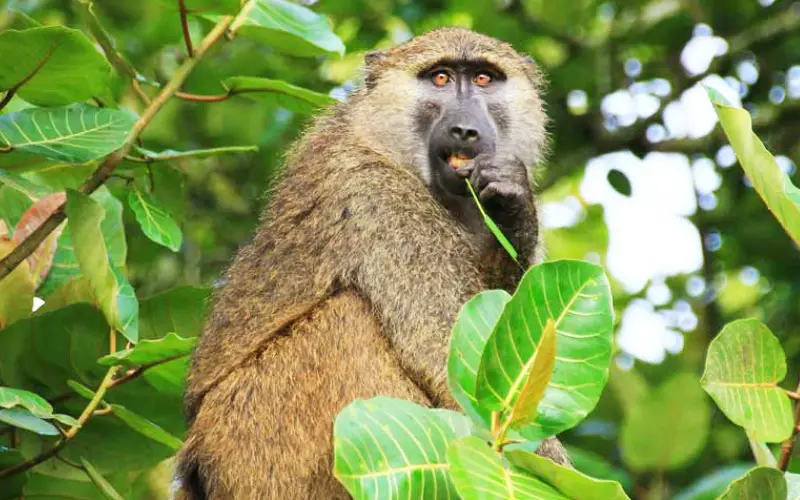
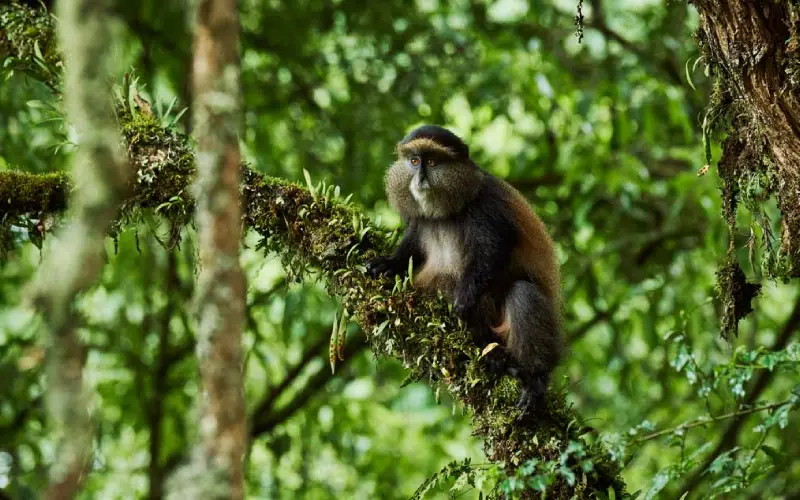
Although chimpanzees are the main highlight, Budongo Forest Reserve is home to a variety of other primates. Visitors may spot large groups of olive baboons along the main road, as well as red-tailed monkeys, blue monkeys, and black-and-white colobus monkeys within the forest. Nocturnal species such as potto and different types of galagos can also be found. Wildlife from nearby Murchison Falls National Park, including buffalo and elephants, occasionally move into the forest, though sightings are uncommon. The area is also rich in biodiversity, with over 360 bird species and around 250 butterfly species recorded.
Scenery
Budongo Forest Reserve may not offer wide scenic views, but its interior has a rich, jungle-like atmosphere that feels truly immersive. The forest is home to an impressive diversity of trees, including towering African mahoganies that can reach up to 60 meters (200 feet) in height. You may also notice strangler figs, which grow around host trees and eventually take over, often leaving a hollow trunk behind. Chimpanzees communicate by drumming on the large, buttressed trunks of the Uganda ironwood (muhimbi), and they often build their nests high in the canopy of these same trees.
Activities
Guided chimpanzee trekking in Budongo Forest Reserve focuses on a habituated group of about 80 individuals, mainly found around Kaniyo Pabidi. This is the most popular activity and is usually offered twice a day, with departures at 8:00 AM and 2:00 PM. Sightings are generally more reliable in the morning. Birdwatching walks are another key activity, offering excellent chances to spot rare species, supported by knowledgeable and experienced guides.
Weather & Climate
In Budongo Forest Reserve, daytime temperatures stay fairly consistent throughout the year, averaging around 29°C (84°F) due to its location near the equator. The Wet season runs from March to November, with lighter rainfall typically experienced in June and July. The Dry season, from December to February, brings very little rain, offering relief from humidity, although temperatures can feel quite hot.
Best Time To Visit
Chimpanzee trekking in Budongo Forest Reserve is available year-round. Walking conditions are easiest during the Dry season (December to February) and again around June and July, when rainfall briefly reduces and forest trails are less muddy. However, recent trends show that the best chances of seeing chimpanzees are usually between April and August, even though this period may include some rain.
Want To Visit Budongo Forest
No data was found
​Wildlife & Animals – Budongo Forest

The main highlight of Budongo Forest Reserve is tracking a habituated group of about 80 chimpanzees around Kaniyo Pabidi. Guided by an expert ranger, you will walk through forest trails in search of them. Once the chimpanzees are found, you are allowed to spend up to one hour observing their behavior. They may be feeding in the treetops, resting, or grooming on the ground. If they are moving through the forest, following them can be an exciting and active experience.

Gorilla
Chimpanzee
Rhino
Lion
Leopard
Cheetah
Hippo
Buffalo
Zebra
Wildebeest
Elephant
Giraffe
Wildlife Highlights

Besides chimpanzees, Budongo Forest Reserve is home to several other primates that can be seen along the forest trails, including black-and-white colobus, red-tailed monkeys, blue monkeys, and olive baboons. At night, you may find nocturnal species such as potto and different types of galagos.

The forest also shelters the elusive tree pangolin, which is rarely seen. On the ground, watch for the small checkered elephant shrew, while the giant forest squirrel can often be spotted in the trees above. After dark, the loud calls of tree hyrax are sometimes heard echoing through the forest.

Best Time for Wildlife Viewing

Chimpanzee trekking in Budongo Forest Reserve is possible year-round, though recent records show the highest success in spotting chimps occurs between April and August.

For the most comfortable walking conditions, the drier months—from December to March and again in June and July—are ideal. After heavy rainfall, forest trails can become muddy and more challenging to navigate.

Want To Visit Budongo Forest
No data was found
Wildlife Photos
​Birds – Budongo Forest
Budongo Forest Reserve hosts over 360 bird species, including around 60 West and Central African species that are rare in East Africa. It is Uganda’s second most important site for Guinea-Congo forest specialists, after Semuliki National Park. One standout species is Puvel’s illadopsis, found only here in East Africa, which is vocal and often seen along the forest paths near the chimp trekking area at Kaniyo Pabidi. Birding enthusiasts should explore the Masindi–Butiaba road, especially the section known as the ‘Royal Mile’, considered one of the best spots in East Africa to find species such as African dwarf kingfisher, chocolate-backed kingfisher, white-thighed hornbill, Ituri batis, and yellow-footed flycatcher.

Notable Birds in Budongo Forest

No data was found
Best Time for Bird Watching

Birdlife in Budongo Forest Reserve is rewarding throughout the year. The main fruiting season runs from June to September, providing abundant food and bringing many birds into their breeding plumage. Migratory species are present from November to April, although they are not the main focus for birdwatching here. December to February is the driest period, while April to May and September to October experience the heaviest rainfall. Heavy rains can make some roads impassable, and slippery forest trails may limit the time available for birdwatching.

Want To Visit Budongo Forest
No data was found
Facts & Figures

Bird Species

450+

Migratory Birds

Nov to Apr

Best Time To Visit – Budongo Forest

Jan

Feb

Mar

Apr

May

Jun

Jul

Aug

Sep

Oct

Nov

Dec

Viewing monkeys and trekking chimpanzees in Budongo Forest Reserve is rewarding throughout the year. In recent years, the highest success in spotting chimpanzees has been recorded between April and August. Walking is generally easiest during the Dry season, from December to February, and also in June and July, when rainfall is lighter and forest trails are less muddy.
Best Time
April to August (Best for chimp trekking)
High Season
June to September (Most people visit Uganda at this time because it is the peak season for gorilla trekking)
Low Season
March to May and October to November
Best Weather
June and July (Lower temperatures and less rainfall)
Worst Weather
April to May and August to October (More rainfall, forest trails might become slippery), January and February (It can get uncomfortably hot)
December to February – Dry Season
Forest trails are drier, making chimpanzee trekking easier
Sunny conditions with very little rainfall
Lower risk of malaria due to fewer mosquitoes
Temperatures can be quite high
March to November – Wet Season
In recent years, April to August has offered the most reliable chimpanzee trekking
Much of this period falls in the low season, so visitor numbers are lower
Migratory birds are typically present from November to April
Budongo Forest Reserve is in a relatively dry region, so rain rarely disrupts trips
Heavy rains can make some roads difficult to navigate and forest trails slippery
Want To Visit Budongo Forest
No data was found
Wildlife Photos
Weather & Climate – Budongo Forest
Budongo Forest Reserve has a hot, tropical climate. Daytime temperatures average around 29°C (84°F), while nights can cool to about 18°C (64°F). The Wet season lasts from March to November, with rain often falling as short but intense storms. During the Dry season, from December to February, rainfall is minimal.
Dry Season – December to February
  • From December to February, Budongo Forest Reserve enjoys clear, sunny skies and the year’s highest temperatures. Daytime averages reach around 29°C (84°F), cooling to about 19°C (66°F) at night. Humidity during this period is relatively low.
Wet Season – March to November
  • March, April & May – Rainfall rises from March, peaking in April. Daytime temperatures average around 29°C (84°F), cooling to 19°C (66°F) at night. Forest trails can become slippery and harder to navigate.


  • June & July – A slightly drier period within the Wet season. Rainfall is lower than in April and May but still significant. Daytime temperatures are around 28°C (82°F).


  • August, September, October & November – Rain returns during these months. It does not rain every day, but storms can be heavy when they occur. October sees the highest rainfall, which eases somewhat in November. Forest trails may be slippery and more challenging to walk.
Want To Visit Budongo Forest
No data was found
Budongo Forest
Budongo Forest Photos
uganda chimpazee
​Getting There – Budongo Forest

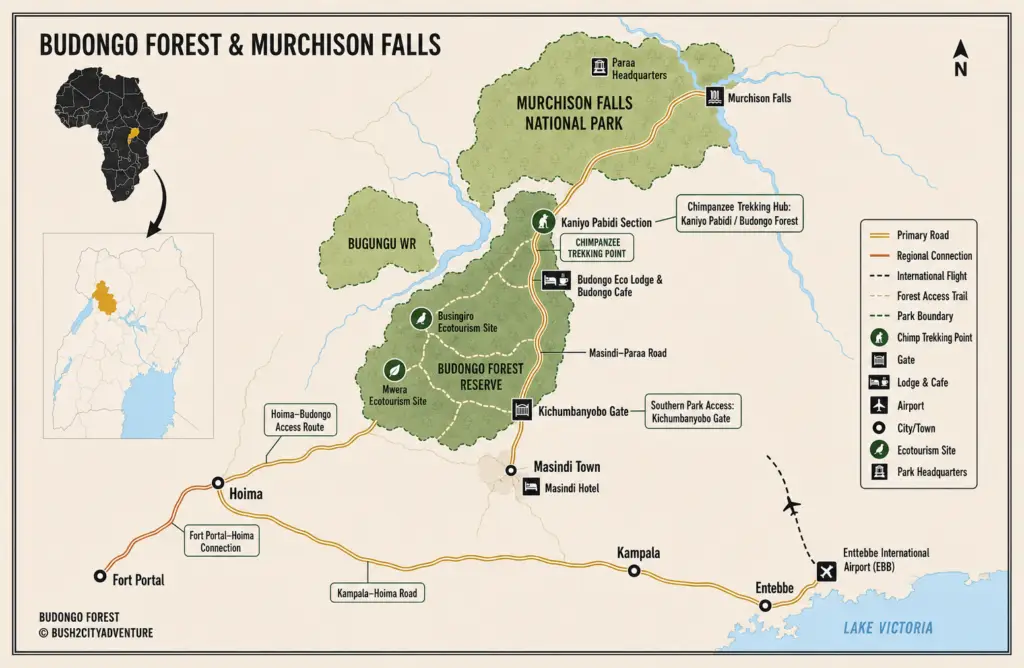
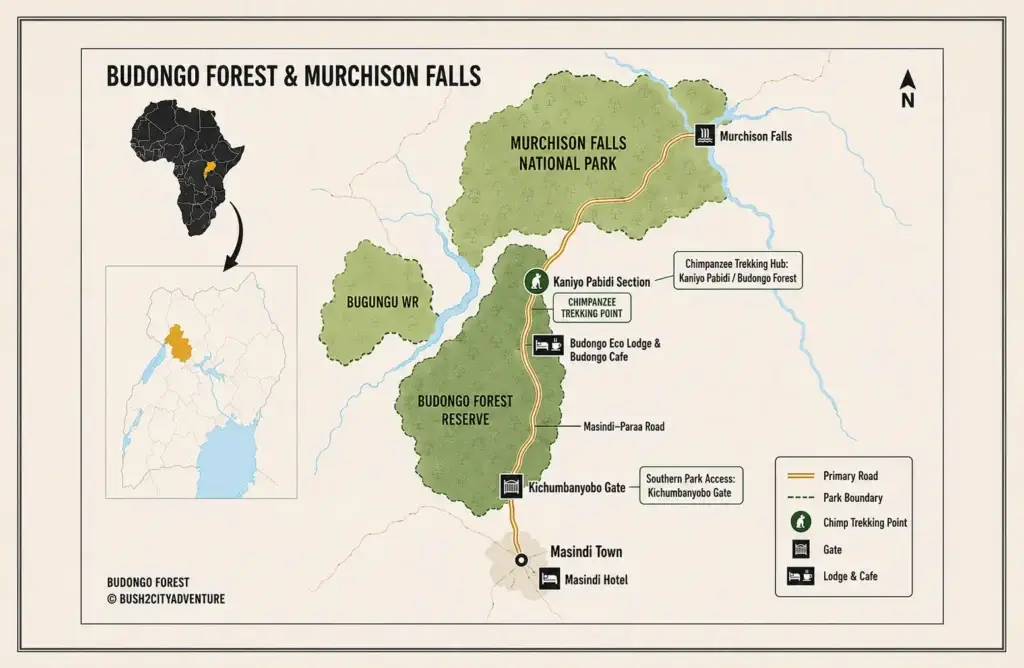
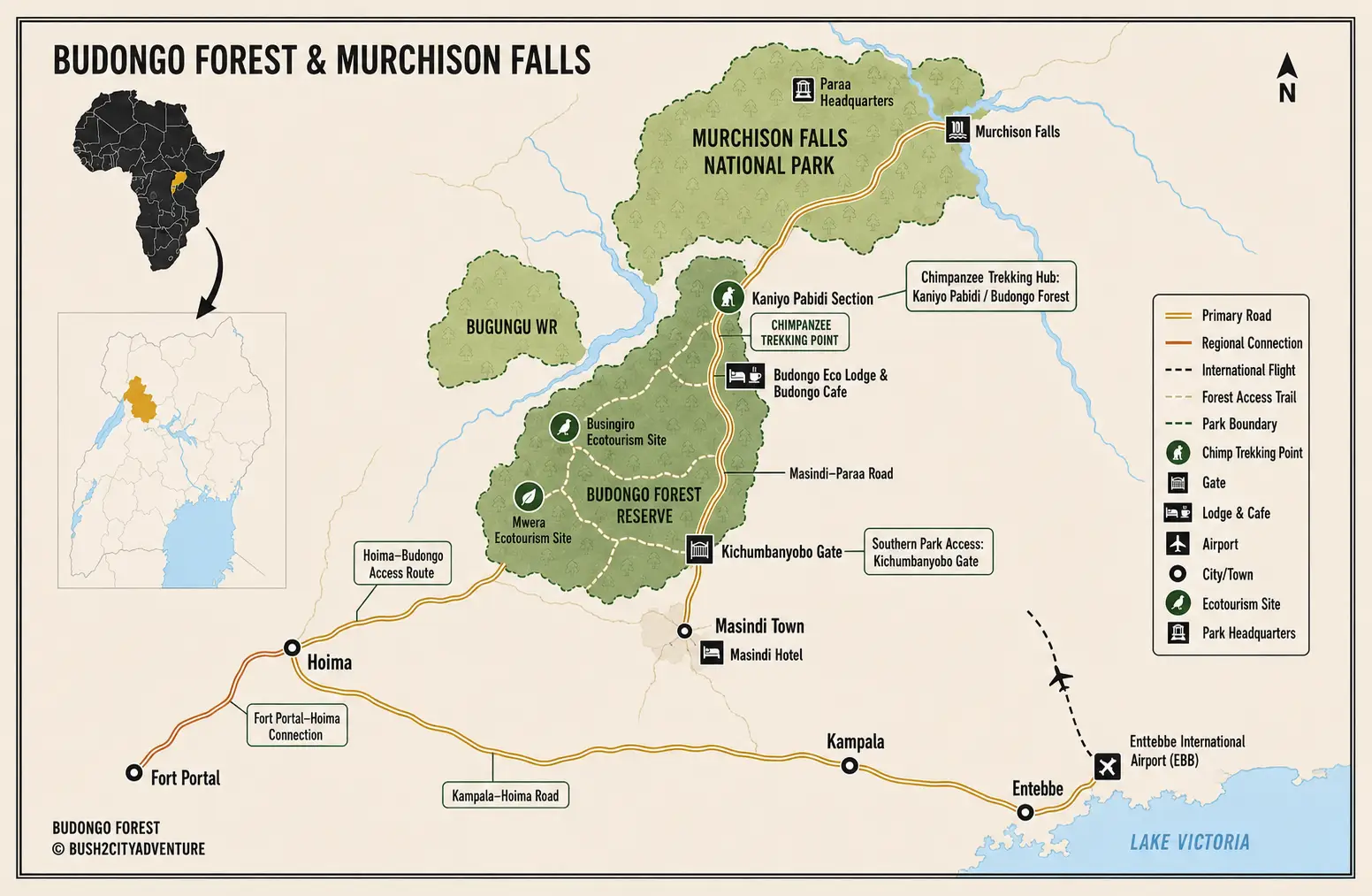
Kaniyo Pabidi, the main hub for chimpanzee trekking in Budongo Forest Reserve, is often visited on the way to or from Murchison Falls National Park. It sits alongside the main paved road linking the capital, Kampala, to Paraa (the park headquarters) via the small town of Masindi. Travel time is roughly 1 hour* from the lodges near Paraa, or about 45 minutes* from Masindi.


Kaniyo Pabidi is around 240 km (150 mi) north of Kampala and another 40 km (25 mi) from Entebbe. Driving from Kampala typically takes at least 5 hours*, with an extra hour* from Entebbe. From the southwest, the 280 km (175 mi) journey from Fort Portal takes approximately 6 hours*.


Entebbe International Airport (EBB) is the main entry point into Uganda, located about 46 km (29 mi) from Kampala. If you book your trip with Bush 2 City Adventure, airport pickup is included, and we can also collect you from your hotel.

*Driving times are only a rough indication. You should always consider the possibility of significant delays.
Main Park Map
Airlines & Ticket Prices

To book your flight to Entebbe International Airport (EBB), check travel sites such as Skyscanner and also visit airline websites directly. These sources will show available flights, schedules, and current ticket prices.

Domestic Flights

Domestic flights—either chartered or scheduled—are usually arranged by Bush 2 City Adventure as part of your safari package. You can fly to Pakuba Airfield from Entebbe International Airport (EBB) or Kajjansi Airfield using either scheduled or chartered flights. The following airlines operate scheduled services:

Passport, Visa & Other Entry Requirements

Please check our How To Get to Uganda page to learn more about passport, visa and other entry requirements.

Want To Visit Budongo Forest
No data was found
​Malaria & Safety – Budongo Forest
Safety

Budongo Forest Reserve is generally very safe to visit. Wildlife reserves and national parks in Uganda experience almost no crime, and your guide will ensure your safety during your visit. For the latest information on safety in Budongo Forest and across Uganda, refer to official government travel advisories (see the “Government Travel Advice for Uganda” link below).

Malaria & Vaccinations

Precautions against malaria and some vaccinations are recommended before visiting Budongo Forest Reserve. Consult your local travel clinic or doctor before your trip. Malaria protection includes taking antimalarial medication and applying mosquito repellent—products containing DEET are the most effective. Wearing clothing that covers exposed skin in the evening, when mosquitoes are most active, is also advised.

Wildlife Viewing

Chimpanzee trekking in Budongo Forest Reserve is generally very safe. When you follow your guide’s instructions, the habituated chimpanzees pose no threat. Be sure to pay close attention during the safety briefing before your trek. For additional guidance, see the “Chimp Trekking Safety Precautions” section below.

Want To Visit Budongo Forest
No data was found
Accommodations – Budongo Forest
Want To Visit Budongo Forest
No data was found
Overview – Budongo Forest
Budongo Forest Reserve is one of East Africa’s largest and most diverse rainforests, home to around 800 chimpanzees—the biggest population in Uganda. The forest lies along the edge of the Albertine Rift escarpment and forms part of the wider Murchison Falls Conservation Area, bordering Murchison Falls National Park. The main activity area is Kaniyo Pabidi, a less crowded chimpanzee trekking site that is also highly regarded for birdwatching.
uganda chimpazee
Best Time To Go
April to August (Best for chimp trekking)
High Season
June to September (Peak time for Uganda)
Size
790km² / 305mi²
Altitude
728-1,145m / 2,388-3,757ft
Pros & Cons
Chimpanzee trekking here is more affordable compared to Kibale National Park
Conveniently accessible from Murchison Falls National Park and Masindi Town
Highly knowledgeable and professional guides enhance the experience
Low visitor numbers offer a more exclusive and peaceful safari
Outstanding birdwatching opportunities, including rare and localized species
Beautiful, untouched forest with a rich, jungle-like atmosphere
Accommodation options nearby are limited
Chimpanzee sightings can be less predictable during the rainy season compared to Kibale
Wildlife
Although chimpanzees are the main highlight, Budongo Forest Reserve is home to a variety of other primates. Visitors may spot large groups of olive baboons along the main road, as well as red-tailed monkeys, blue monkeys, and black-and-white colobus monkeys within the forest. Nocturnal species such as potto and different types of galagos can also be found. Wildlife from nearby Murchison Falls National Park, including buffalo and elephants, occasionally move into the forest, though sightings are uncommon. The area is also rich in biodiversity, with over 360 bird species and around 250 butterfly species recorded.
Scenery
Budongo Forest Reserve may not offer wide scenic views, but its interior has a rich, jungle-like atmosphere that feels truly immersive. The forest is home to an impressive diversity of trees, including towering African mahoganies that can reach up to 60 meters (200 feet) in height. You may also notice strangler figs, which grow around host trees and eventually take over, often leaving a hollow trunk behind. Chimpanzees communicate by drumming on the large, buttressed trunks of the Uganda ironwood (muhimbi), and they often build their nests high in the canopy of these same trees.
Weather & Climate
In Budongo Forest Reserve, daytime temperatures stay fairly consistent throughout the year, averaging around 29°C (84°F) due to its location near the equator. The Wet season runs from March to November, with lighter rainfall typically experienced in June and July. The Dry season, from December to February, brings very little rain, offering relief from humidity, although temperatures can feel quite hot.
Best Time To Visit
Chimpanzee trekking in Budongo Forest Reserve is available year-round. Walking conditions are easiest during the Dry season (December to February) and again around June and July, when rainfall briefly reduces and forest trails are less muddy. However, recent trends show that the best chances of seeing chimpanzees are usually between April and August, even though this period may include some rain.
Want To Visit Budongo Forest
No data was found
​Wildlife & Animals – Budongo Forest

The main highlight of Budongo Forest Reserve is tracking a habituated group of about 80 chimpanzees around Kaniyo Pabidi. Guided by an expert ranger, you will walk through forest trails in search of them. Once the chimpanzees are found, you are allowed to spend up to one hour observing their behavior. They may be feeding in the treetops, resting, or grooming on the ground. If they are moving through the forest, following them can be an exciting and active experience.

Gorilla
Chimpanzee
Rhino
Lion
Leopard
Cheetah
Hippo
Buffalo
Zebra
Wildebeest
Elephant
Giraffe
Wildlife Highlights

Besides chimpanzees, Budongo Forest Reserve is home to several other primates that can be seen along the forest trails, including black-and-white colobus, red-tailed monkeys, blue monkeys, and olive baboons. At night, you may find nocturnal species such as potto and different types of galagos.

The forest also shelters the elusive tree pangolin, which is rarely seen. On the ground, watch for the small checkered elephant shrew, while the giant forest squirrel can often be spotted in the trees above. After dark, the loud calls of tree hyrax are sometimes heard echoing through the forest.

Best Time for Wildlife Viewing

Chimpanzee trekking in Budongo Forest Reserve is possible year-round, though recent records show the highest success in spotting chimps occurs between April and August.

For the most comfortable walking conditions, the drier months—from December to March and again in June and July—are ideal. After heavy rainfall, forest trails can become muddy and more challenging to navigate.

Want To Visit Budongo Forest
No data was found
Wildlife Photos
​Birds – Budongo Forest
Budongo Forest Reserve hosts over 360 bird species, including around 60 West and Central African species that are rare in East Africa. It is Uganda’s second most important site for Guinea-Congo forest specialists, after Semuliki National Park. One standout species is Puvel’s illadopsis, found only here in East Africa, which is vocal and often seen along the forest paths near the chimp trekking area at Kaniyo Pabidi. Birding enthusiasts should explore the Masindi–Butiaba road, especially the section known as the ‘Royal Mile’, considered one of the best spots in East Africa to find species such as African dwarf kingfisher, chocolate-backed kingfisher, white-thighed hornbill, Ituri batis, and yellow-footed flycatcher.

Notable Birds in Budongo Forest

No data was found
Best Time for Bird Watching

Birdlife in Budongo Forest Reserve is rewarding throughout the year. The main fruiting season runs from June to September, providing abundant food and bringing many birds into their breeding plumage. Migratory species are present from November to April, although they are not the main focus for birdwatching here. December to February is the driest period, while April to May and September to October experience the heaviest rainfall. Heavy rains can make some roads impassable, and slippery forest trails may limit the time available for birdwatching.

Want To Visit Budongo Forest
No data was found
Facts & Figures

Bird Species

450+

Migratory Birds

Nov to Apr

Best Time To Visit – Budongo Forest

Jan

Feb

Mar

Apr

May

Jun

Jul

Aug

Sep

Oct

Nov

Dec

Viewing monkeys and trekking chimpanzees in Budongo Forest Reserve is rewarding throughout the year. In recent years, the highest success in spotting chimpanzees has been recorded between April and August. Walking is generally easiest during the Dry season, from December to February, and also in June and July, when rainfall is lighter and forest trails are less muddy.
Best Time
April to August (Best for chimp trekking)
High Season
June to September (Most people visit Uganda at this time because it is the peak season for gorilla trekking)
Low Season
March to May and October to November
Best Weather
June and July (Lower temperatures and less rainfall)
Worst Weather
April to May and August to October (More rainfall, forest trails might become slippery), January and February (It can get uncomfortably hot)
December to February – Dry Season
Forest trails are drier, making chimpanzee trekking easier
Sunny conditions with very little rainfall
Lower risk of malaria due to fewer mosquitoes
Temperatures can be quite high
March to November – Wet Season
In recent years, April to August has offered the most reliable chimpanzee trekking
Much of this period falls in the low season, so visitor numbers are lower
Migratory birds are typically present from November to April
Budongo Forest Reserve is in a relatively dry region, so rain rarely disrupts trips
Heavy rains can make some roads difficult to navigate and forest trails slippery
Want To Visit Budongo Forest
No data was found
Wildlife Photos
Weather & Climate – Budongo Forest
Budongo Forest Reserve has a hot, tropical climate. Daytime temperatures average around 29°C (84°F), while nights can cool to about 18°C (64°F). The Wet season lasts from March to November, with rain often falling as short but intense storms. During the Dry season, from December to February, rainfall is minimal.
Dry Season – December to February
  • From December to February, Budongo Forest Reserve enjoys clear, sunny skies and the year’s highest temperatures. Daytime averages reach around 29°C (84°F), cooling to about 19°C (66°F) at night. Humidity during this period is relatively low.
Wet Season – March to November
  • March, April & May – Rainfall rises from March, peaking in April. Daytime temperatures average around 29°C (84°F), cooling to 19°C (66°F) at night. Forest trails can become slippery and harder to navigate.


  • June & July – A slightly drier period within the Wet season. Rainfall is lower than in April and May but still significant. Daytime temperatures are around 28°C (82°F).


  • August, September, October & November – Rain returns during these months. It does not rain every day, but storms can be heavy when they occur. October sees the highest rainfall, which eases somewhat in November. Forest trails may be slippery and more challenging to walk.
Want To Visit Budongo Forest
No data was found
Budongo Forest
Budongo Forest Photos
uganda chimpazee
​Getting There – Budongo Forest

Kaniyo Pabidi, the main hub for chimpanzee trekking in Budongo Forest Reserve, is often visited on the way to or from Murchison Falls National Park. It sits alongside the main paved road linking the capital, Kampala, to Paraa (the park headquarters) via the small town of Masindi. Travel time is roughly 1 hour* from the lodges near Paraa, or about 45 minutes* from Masindi.


Kaniyo Pabidi is around 240 km (150 mi) north of Kampala and another 40 km (25 mi) from Entebbe. Driving from Kampala typically takes at least 5 hours*, with an extra hour* from Entebbe. From the southwest, the 280 km (175 mi) journey from Fort Portal takes approximately 6 hours*.


Entebbe International Airport (EBB) is the main entry point into Uganda, located about 46 km (29 mi) from Kampala. If you book your trip with Bush 2 City Adventure, airport pickup is included, and we can also collect you from your hotel.
*Driving times are only a rough indication. You should always consider the possibility of significant delays.
Main Park Map
Airlines & Ticket Prices

To book your flight to Entebbe International Airport (EBB), check travel sites such as Skyscanner and also visit airline websites directly. These sources will show available flights, schedules, and current ticket prices.

Domestic Flights

Domestic flights—either chartered or scheduled—are usually arranged by Bush 2 City Adventure as part of your safari package. You can fly to Pakuba Airfield from Entebbe International Airport (EBB) or Kajjansi Airfield using either scheduled or chartered flights. The following airlines operate scheduled services:

Passport, Visa & Other Entry Requirements

Please check our How To Get to Uganda page to learn more about passport, visa and other entry requirements.

Want To Visit Budongo Forest
No data was found
​Malaria & Safety – Budongo Forest
Safety

Budongo Forest Reserve is generally very safe to visit. Wildlife reserves and national parks in Uganda experience almost no crime, and your guide will ensure your safety during your visit. For the latest information on safety in Budongo Forest and across Uganda, refer to official government travel advisories (see the “Government Travel Advice for Uganda” link below).

Malaria & Vaccinations

Precautions against malaria and some vaccinations are recommended before visiting Budongo Forest Reserve. Consult your local travel clinic or doctor before your trip. Malaria protection includes taking antimalarial medication and applying mosquito repellent—products containing DEET are the most effective. Wearing clothing that covers exposed skin in the evening, when mosquitoes are most active, is also advised.

Wildlife Viewing

Chimpanzee trekking in Budongo Forest Reserve is generally very safe. When you follow your guide’s instructions, the habituated chimpanzees pose no threat. Be sure to pay close attention during the safety briefing before your trek. For additional guidance, see the “Chimp Trekking Safety Precautions” section below.

Want To Visit Budongo Forest
No data was found

Explore Budongo Forest Safari Tours

No data was found

Book your Kilimanjaro trek

Our team is always here to help

General Travel Safety Precautions

Embarking on an African safari promises an adventure of a lifetime, showcasing the continent’s rich wildlife, breathtaking landscapes, and diverse cultures. While safaris are widely considered safe, especially those organized through reputable tour operators, it’s prudent to take certain precautions to ensure a smooth and secure experience. Here are some essential safety tips to consider:

Cities & Urban Areas: Safety Precautions

Traveling through Africa offers an enriching experience filled with breathtaking landscapes, diverse cultures, and unparalleled wildlife encounters. While it’s generally safe, especially on organized tours or safaris, navigating urban environments requires a bit of savvy to ensure your trip remains worry-free. Here are some straightforward tips to keep in mind, whether you’re exploring bustling metropolises or serene landscapes:

Wildlife Viewing Safety Precautions

Exploring the wild through a safari adventure is an exhilarating experience that brings you closer to nature’s most fascinating wildlife. Whether you opt for a guided tour with an experienced professional or decide to navigate the trails on a self-drive journey, safety is paramount to ensure an enjoyable and incident-free adventure. Here are some essential safety guidelines and tips to help you navigate your safari safely:

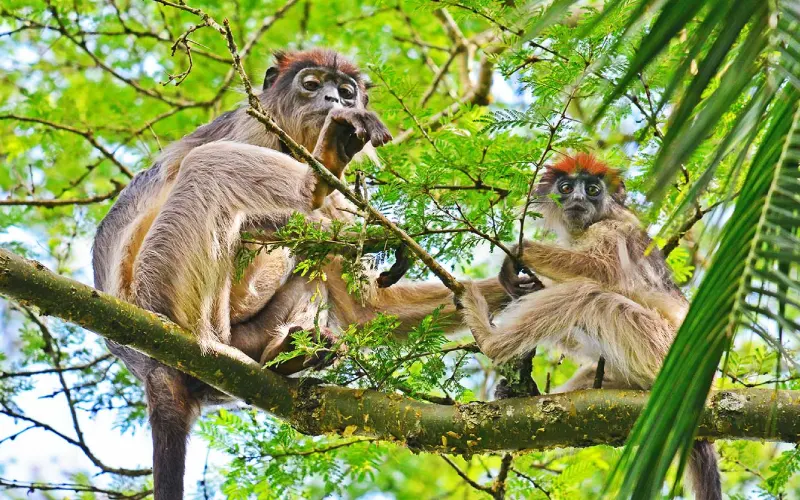
Photo Gallery of Budongo Forest

Map of Budongo Forest

Photo Gallery of Budongo Forest

Main Park Map

Photo Gallery of Budongo Forest

Map of Budongo Forest

Photo Gallery

Photo Gallery

Photo Gallery